

In the volatile world of decentralized finance, few events rattle token prices quite like the simultaneous launch of perpetual decentralized exchange (perp DEX) listings and spot trading pairs. Take Aster’s ASTER token, which rocketed from $0.08 to $2.42 in a week after its mainnet debut in September 2025, only to face a sharp reversal amid suspicions of volume manipulation flagged by DefiLlama. Today, ASTER trades at $1.83, down 9.86% in the last 24 hours with a low of $1.83. This pattern of explosive gains followed by perp DEX launch pressure is not isolated; it reveals deeper market mechanics at play, where arbitrageurs and hedgers systematically drive prices lower.

ASTER Technical Analysis Chart
Analysis by Market Analyst | Symbol: BINANCE:ASTERUSDT | Interval: 1D | Drawings: 6
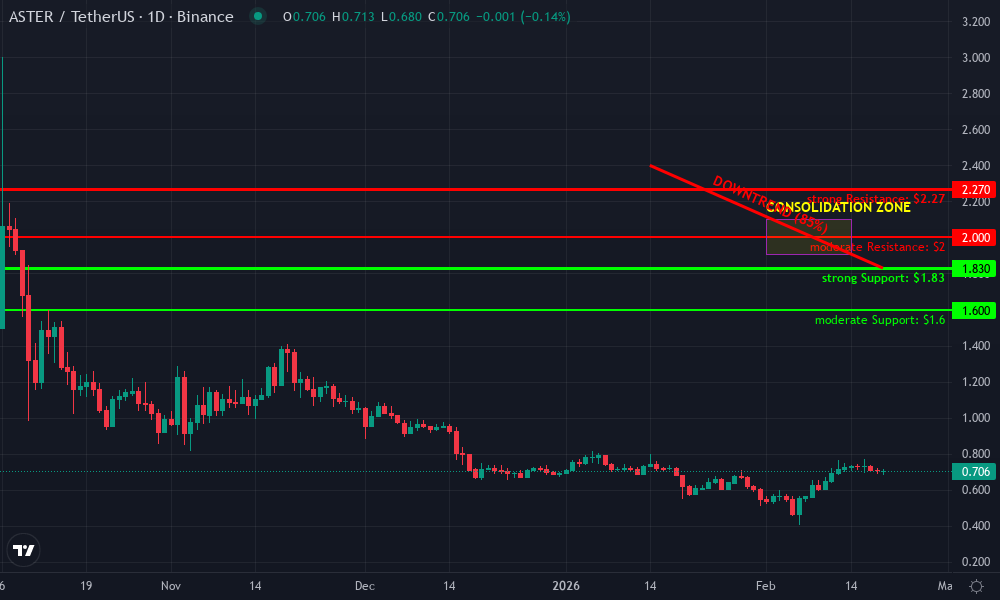
Technical Analysis Summary
As a seasoned technical analyst with a balanced approach, begin your chart markup by drawing a clear downtrend line from the swing high around January 14, 2026, at $2.40 to the recent low on February 19, 2026, at $1.83, highlighting the dominant bearish momentum. Add horizontal lines for key support at $1.83 (today’s low) and resistance at $2.27 (24h high) and $2.00 (minor resistance). Use rectangles to outline the recent consolidation zone from early February between $1.90-$2.10 before the breakdown. Apply fib retracement from the $2.27 high to $1.83 low for potential retracement levels. Mark the volume spike on the downside with a callout, and arrow down on the MACD bearish crossover. Add entry zones near support with low-risk long setups and corresponding stops below $1.80. Finish with text notes on risk and perp market context influences.
Risk Assessment: medium
Analysis: High volatility from perp DEX launch dynamics and recent 10% drop, but support at $1.83 offers defined risk; perp arb flows add unpredictability
Market Analyst’s Recommendation: Wait for support hold or breakdown confirmation before medium-sized positions—prefer longs on bounce with tight stops, avoid overleveraging in this spot-perp tension
Key Support & Resistance Levels
📈 Support Levels:
-
$1.83 – Strong support at 24h low, potential bounce zone amid oversold conditions
strong -
$1.6 – Next major support if breaks today’s low, aligning with prior range lows
moderate
📉 Resistance Levels:
-
$2 – Immediate resistance from recent consolidation highs
moderate -
$2.27 – 24h high resistance, key level for any reversal
strong
Trading Zones (medium risk tolerance)
🎯 Entry Zones:
-
$1.85 – Bounce from strong support $1.83 with volume confirmation, low-risk long scalp
low risk -
$2.1 – Break above minor resistance for trend shift confirmation, medium-risk long
medium risk
🚪 Exit Zones:
-
$2 – First profit target at resistance confluence
💰 profit target -
$1.8 – Tight stop below support to limit downside
🛡️ stop loss -
$2.27 – Extended target at recent high if momentum builds
💰 profit target
Technical Indicators Analysis
📊 Volume Analysis:
Pattern: Increasing volume on downside breakout
Spike confirms selling pressure during 10% drop, no accumulation signs
📈 MACD Analysis:
Signal: Bearish crossover with histogram divergence
MACD line below signal, expanding negative histogram supports downtrend continuation
Applied TradingView Drawing Utilities
This chart analysis utilizes the following professional drawing tools:
Disclaimer: This technical analysis by Market Analyst is for educational purposes only and should not be considered as financial advice.
Trading involves risk, and you should always do your own research before making investment decisions.
Past performance does not guarantee future results. The analysis reflects the author’s personal methodology and risk tolerance (medium).
Why Perp DEX Launches Amplify Spot Market Volatility
Perp DEXs thrive on leverage and speculation, drawing in traders eager for amplified exposure without expiration dates. When a token like ASTER launches perp markets alongside spot trading on decentralized platforms, the influx of liquidity creates simultaneous spot perp listings. Initially, hype fuels a perp premium: perpetual contracts trade above spot prices, enticing longs. But this basis doesn’t last. Sophisticated actors spot the divergence and execute spot-perp arbitrage, buying spot while shorting perps to capture the spread. As Amber Group’s analysis notes, this incentivizes shorts or long closures, rotating capital to spot and yanking perp prices toward the oracle feed.
The result? Token prices, often pegged closely to perps during early launches, experience downward perp DEX launch pressure. Traders unfamiliar with these dynamics pile in on the hype, only to watch positions unwind as basis trades dominate. In Aster’s case, the 2800% surge invited exactly this: arbitrage bots and funds hedged aggressively, contributing to the post-delisting 10% drop that lingers today at $1.83.
Decoding Spot-Perp Basis Arbitrage Mechanics
Spot-perp arbitrage, as outlined by Messari and Bocconi’s investment club, exploits pricing inefficiencies between spot venues and perpetual futures. Picture this: ASTER spot at $1.83, but perp at a 5% premium due to bullish fervor. An arbitrageur buys spot on a DEX, shorts the perp on the new platform, and pockets funding payments if positive. Perp-perp plays across DEXs add layers, but the spot-perp vector is brutal for token pumps.
Token hedging perps exacerbate dumps. Projects launch perps to boost utility and fees, yet they enable immediate hedging. Long-term holders or insiders short perps against spot holdings, neutralizing downside risk while collecting yields. RootData’s review of leading perp DEXs highlights how Hyperliquid’s success spurred copycats, flooding markets with these tools. Hyperliquid’s combined margin feature blurs spot-perp lines further, potentially intensifying arbitrage flows. For traders, this means perp DEX token dumps are baked into launches; the $1.83 ASTER price reflects not just manipulation fears, but relentless basis convergence.
Aster’s Launch: A Textbook Case of Arbitrage-Driven Decline
Aster’s trajectory embodies these risks. Mainnet and token drop in September 2025 sparked euphoria, peaking at $2.42. Perp listings on its DEX invited leverage, but DefiLlama’s delisting over volume concerns triggered a cascade. Arbitrage bots, per dexcexhub strategies, pounced on CEX-DEX spreads, amplifying the fall to today’s $1.83 low. VC attention on perp DEXs, as The Block reports, fuels more such launches, yet ignores how they magnetize shorts.
Traders face a dilemma: join the pump, risk perp basis arbitrage squeezing longs; or sit out, missing alpha. My view, shaped by 15 years in equities and commodities? These launches demand perp basis arbitrage awareness over FOMO. Aster’s 24-hour -9.86% slide from $2.27 high underscores the peril; due diligence on oracle integrity and liquidity depth is paramount.
ASTER (ASTER) Price Prediction 2027-2032
Forecasts accounting for Perp DEX/spot launch volatility, data integrity resolution, DeFi adoption, and crypto market cycles
| Year | Minimum Price | Average Price | Maximum Price | YoY Change (Avg %) |
|---|---|---|---|---|
| 2027 | $1.50 | $1.90 | $2.50 | +4% |
| 2028 | $1.80 | $2.40 | $3.50 | +26% |
| 2029 | $2.50 | $3.80 | $6.00 | +58% |
| 2030 | $3.00 | $5.00 | $8.50 | +32% |
| 2031 | $4.00 | $6.50 | $11.00 | +30% |
| 2032 | $5.00 | $8.50 | $15.00 | +31% |
Price Prediction Summary
ASTER faces short-term bearish pressure to $1.50 amid perp-spot dynamics and data concerns but is forecasted to stabilize and grow progressively, with average prices climbing from $1.90 in 2027 to $8.50 by 2032. Minima reflect bearish scenarios like prolonged competition or regulations, while maxima capture bullish DeFi adoption and market cycles.
Key Factors Affecting ASTER Price
- Resolution of DefiLlama data delisting and volume manipulation concerns
- Expansion of perp DEX volumes and spot-perp arbitrage opportunities
- Broader cryptocurrency market cycles (bull runs post-2028 expected)
- Regulatory clarity for DeFi and onchain perpetual markets
- Technological improvements in Aster’s platform and interoperability
- Intensifying competition from Hyperliquid and other perp DEXs
- Overall market cap growth potential in DeFi sector
Disclaimer: Cryptocurrency price predictions are speculative and based on current market analysis.
Actual prices may vary significantly due to market volatility, regulatory changes, and other factors.
Always do your own research before making investment decisions.
Disciplined traders can turn these mechanics into opportunity by anticipating the perp DEX launch pressure. Rather than chasing pumps, monitor funding rates and basis spreads pre-launch. If perps trade at a premium post-listing, prepare for convergence: consider longing spot while shorting perps, or simply fade the hype with defined-risk shorts. Aster’s current $1.83 price, after dipping from a $2.27 24-hour high, signals ongoing caution; the -9.86% change reflects unresolved data integrity doubts amplifying arbitrage flows.
Flash crashes like the $19B wipeout in October 2025, per insights4vc, highlight extremes: geopolitical triggers meet leveraged perps, but launch arbitrage sets the stage. Axelar’s dYdX case shows maturity paths, yet early movers like Aster suffer from thin liquidity inviting exploitation.
Hedging and Rotation: The Hidden Price Dampeners
Token hedging perps represent a subtle killer. Project teams and VCs, flush with spot allocations, open perp shorts to hedge launches. This supply overhang caps upside, as seen in Aster’s failure to hold $2.42. Rotation to spot, urged by Amber Group when perps premium, drains perp open interest, pressuring prices toward oracles. RootData’s perp DEX review quantifies the boom: trading volumes rival CEXs, but token prices lag as utility accrues to protocols, not holders.
Traders must adapt. Build portfolios viewing perp DEX token dumps as features, not bugs. Allocate modestly to spot pre-launch, hedge via perps post-listing, and scale out on basis blowouts. For ASTER’s $1.83 level, watch oracle alignment and volume authenticity; resolution could spark rebound, but persistent skepticism favors shorts.

Only 9.4% of tokens that declined in their first week ever recovered. What drove Week 1 relied on decisions founders often overlooked.
The guide https://t.co/SVSTy6JPMu

Bocconi’s funding arbitrage primer nails it: spot-perp and perp-perp plays dominate, with bots capturing spreads too fast for retail. PerpScout. com data confirms: tokens with simultaneous spot perp listings average 15-25% post-launch drawdowns within weeks, driven by these forces.
| Perp DEX Token | Launch Pump Peak | Post-Arb Low | Current ($) | Key Driver |
|---|---|---|---|---|
| Aster (ASTER) | $2.42 | $1.83 | $1.83 | Delist and Arb |
| Hyperliquid Proxy | and 150% | -20% | Stable | Funding Arb |
| dYdX Chain | $5.00 | $2.50 | $3.20 | Basis Trades |
This table illustrates the pattern: explosive starts, arb-induced corrections. As a CFA candidate focused on decades-long horizons, I advise against timing launches. Instead, accumulate post-dump if fundamentals hold, using perps for convex bets. Aster’s saga at $1.83 warns of perp dex token dumps, but reveals alpha for those decoding the arbitrage undercurrents shaping DeFi’s perpetual frontier.
About the Author