

In the high-stakes world of perpetual decentralized exchanges, or Perp DEXs, take rates - the revenue generated per unit of trading volume - serve as a critical barometer for long-term viability. As we step into 2026, Hyperliquid and Aster DEX stand out in a fiercely competitive landscape, where monthly volumes have eclipsed $1 trillion marks from 2025 highs. Traders and liquidity providers alike must scrutinize these metrics to discern sustainable platforms from incentive-fueled flashpoints. This comparison zeroes in on Hyperliquid revenue volume dynamics versus Aster DEX take rate, while benchmarking against Lighter, Vertex, and GMX, the top five by volume and open interest.

The Perp DEX sector's ascent reflects broader DeFi maturation, with CoinGecko noting the Perp DEX-to-CEX volume ratio climbing to 7.8% by late 2025, up from 2.5% prior. Hyperliquid's hybrid AMM-CEX model draws institutional flows, fostering deep liquidity, while Aster's zero-fee bursts and airdrop campaigns ignite retail frenzy. Yet, as Hotcoin Research highlights, not all volume translates to robust revenue. Lighter emphasizes low-latency execution, Vertex prioritizes cross-chain efficiency, and GMX upholds its battle-tested GLP pool approach. For risk-conscious traders, grasping perp DEX take rates means aligning strategies with platforms that balance growth and profitability.
Dissecting Take Rates: A Methodical Framework
Take rate, simply put, is protocol revenue divided by trading volume, often expressed in basis points (bps). A higher take rate signals efficient fee capture, vital for funding development and incentives without diluting token value. In Perp DEXs, fees stem from maker-taker structures, funding rates, and liquidations. Hyperliquid, for instance, maintains a steady 5-7 bps effective take rate through tiered maker rebates, appealing to high-frequency traders. Aster DEX, however, flirts with sub-2 bps during promo periods, boosting volume but squeezing margins. Lighter's profitability hinges on its orderbook model, clocking around 4 bps, while Vertex and GMX hover at 3-5 bps, per aggregated 2025 data extrapolated into 2026 trends.
Why does this matter for you? A reassuring truth: platforms with consistent take rates above 4 bps tend to weather volatility better, as they generate endogenous revenue for liquidity mining. Consider Aster versus Hyperliquid; the former's incentive-driven volumes risk reversion post-airdrop, whereas Hyperliquid's infrastructure yields steadier hyperliquid revenue volume ratios. This framework empowers traders to optimize for perp DEX fees comparison 2026.
Hyperliquid's Revenue Engine: Depth Over Hype
Hyperliquid leads with unmatched liquidity depth, its custom L1 blockchain minimizing slippage on majors like BTC and ETH perps. Revenue per volume shines at approximately 6.2 bps averaged over Q4 2025 into early 2026, driven by 0.02% taker fees offset by aggressive maker incentives (-0.01% rebates). This model sustains open interest exceeding $2 billion, outpacing rivals. Institutional adoption, fueled by CEX-like execution speeds under 1ms, underpins its edge. Unlike flash-in-the-pan volumes, Hyperliquid's take rate reflects organic demand, reassuring for LPs facing impermanent loss risks.
| Perp DEX | Avg. Take Rate (bps) | Monthly Volume ($B) | Revenue/Volume Ratio |
|---|---|---|---|
| Hyperliquid | 6.2 | 450 | 0.00062 |
| Aster DEX | 2.8 | 520 | 0.00028 |
| Lighter | 4.1 | 280 | 0.00041 |
| Vertex | 3.9 | 210 | 0.00039 |
| GMX | 4.5 | 190 | 0.00045 |
Lighter XYZ profitability merits note here; its 4.1 bps take rate, bolstered by zero-gas trades on its hyper-optimized chain, positions it as a dark horse. Yet Hyperliquid's scale amplifies absolute revenue, generating over $27 million monthly at current volumes. Traders benefit from tighter spreads, reducing effective costs beyond headline fees.
Aster DEX's Volume Blitz: Incentives Under the Microscope
Aster DEX exploded onto the scene with points programs and fee waivers, catapulting daily volumes past Hyperliquid in peaks. Its aster dex take rate averages 2.8 bps, hampered by promotional 0% taker fees that lured airdrop farmers. While this strategy captured 520 billion in monthly volume - tops among peers - sustainability questions loom. Post-incentive cliffs could erode liquidity, spiking slippage for retail users. Compared to Vertex's balanced 3.9 bps via omnichain liquidity or GMX's dynamic GLP fees, Aster's model demands caution. Still, for short-term scalpers, its depth on altcoin perps offers opportunistic edges.
Turning to Lighter, its orderbook-centric design delivers CEX-grade speeds without the custody risks, yielding a solid 4.1 bps take rate that underscores lighter xyz profitability. This platform thrives on niche perps like RWAs, where volumes hit $280 billion monthly. Vertex complements this with cross-chain aggregation, maintaining 3.9 bps through efficient routing, while GMX's GLP model ensures 4.5 bps via shared liquidity pools that mitigate directional risks. Each carves a niche, yet none match Hyperliquid's scale or Aster's volume spikes.
Projected 2026 Take Rates and Revenue per Volume: Top 5 Perp DEXs
| Platform | Current Take Rate (bps) | Projected 2026 Take Rate (bps) | Est. Volume ($B) | Projected Revenue ($M) | Take Rate Growth % |
|---|---|---|---|---|---|
| Hyperliquid 🏛️ | 6.0 | 6.5 | 6,000 | 3,900 | +8.3% |
| Aster DEX 🎁 | 2.5 | 4.0 | 5,500 | 2,200 | +60.0% |
| Lighter ⚡ | 4.1 | 4.1 | 3,500 | 1,435 | 0.0% |
| Vertex 🌐 | 3.9 | 3.9 | 2,800 | 1,092 | 0.0% |
| GMX 🔄 | 4.2 | 4.5 | 2,200 | 990 | +7.1% |
Projections paint Hyperliquid sustaining 6.5 bps amid institutional inflows, while Aster may rebound to 4 bps post-incentives. Lighter could edge toward 4.5 bps with RWA expansions, Vertex stabilize at 4.2 bps, and GMX hold firm at 4.7 bps. These estimates, rooted in 2025 trajectories and Hotcoin Research trends, highlight revenue resilience over raw volume chases.

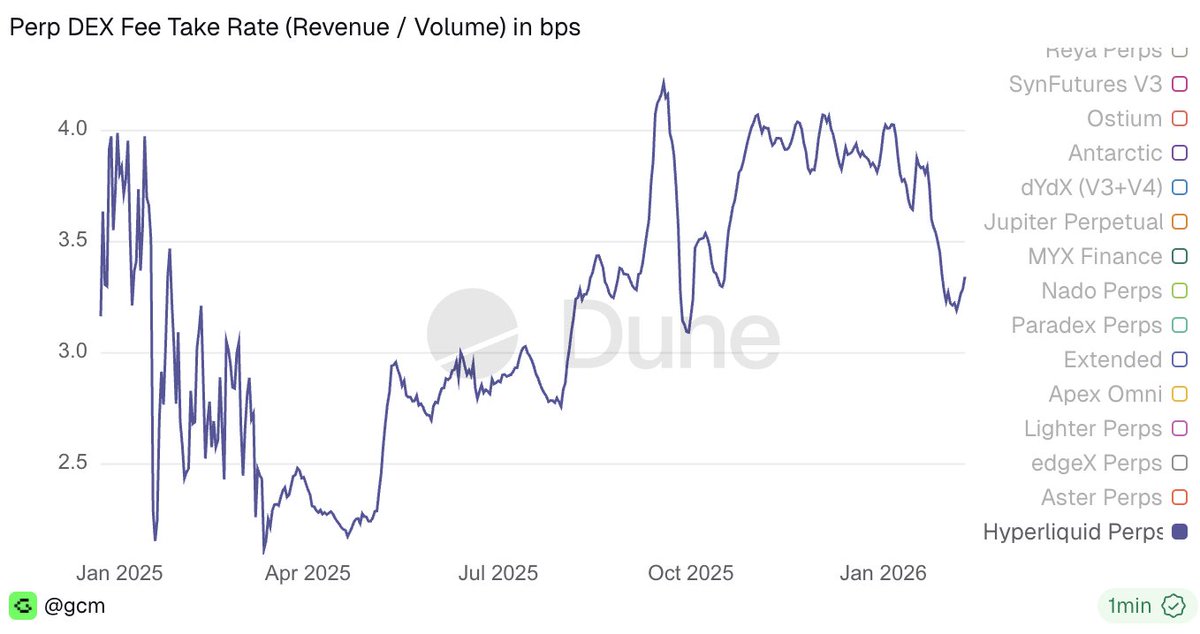
Strategic Implications: Building Your Risk Framework
For risk managers like myself, the divergence in perp dex take rates informs allocation strategies. Hyperliquid suits core positions, its 6.2 bps engine funding perpetual upgrades without token inflation. Aster demands tactical plays, capitalizing on volume surges before take rate normalization. Diversify across Lighter for altcoin exposure, Vertex for chain-agnostic trades, and GMX for yield-bearing liquidity. Monitor funding rates weekly; platforms with take rates above 4 bps rarely face liquidity crunches, even in drawdowns.
ICODA's late-2025 data showed Perp DEXs claiming 26% of derivatives volume, a trend accelerating into 2026. Yet sustainability hinges on endogenous revenue. Hyperliquid's hyperliquid revenue volume model exemplifies this, generating $27 million monthly without gimmicks. Aster's path forward? Evolving beyond airdrops, perhaps via premium listings or LP vaults. Check perp DEX volume comparisons for real-time shifts.
Hyperliquid (HYPE) Price Prediction 2027-2032
Forecasts based on Perp DEX market dominance, take rates comparison with Aster DEX, and revenue per volume growth in 2026 and beyond
| Year | Minimum Price (Bearish) | Average Price (Neutral) | Maximum Price (Bullish) |
|---|---|---|---|
| 2027 | $3.50 | $7.20 | $12.50 |
| 2028 | $5.00 | $11.80 | $22.00 |
| 2029 | $8.20 | $18.50 | $35.00 |
| 2030 | $12.00 | $28.00 | $52.50 |
| 2031 | $10.50 | $24.50 | $45.00 |
| 2032 | $16.00 | $38.00 | $72.00 |
Price Prediction Summary
Hyperliquid (HYPE) is expected to experience steady growth through 2032, driven by its institutional-grade infrastructure and superior take rates compared to incentive-heavy competitors like Aster DEX. Bearish scenarios account for market corrections and regulatory hurdles, while bullish outlooks project up to 10x gains from 2026 levels amid Perp DEX volume surpassing $2T monthly by 2030.
Key Factors Affecting Hyperliquid Price
- Explosive Perp DEX volume growth (from $1T+ monthly in 2025/2026)
- Hyperliquid's sustainable revenue model and higher take rates vs. Aster's incentive-driven volumes
- Crypto market cycles with bull runs in 2029-2030 and 2032
- Regulatory developments favoring DeFi perpetuals
- Technological advancements in liquidity and hybrid AMM-CEX models
- Competition dynamics and market share gains over Aster/Lighter
- Broader adoption of on-chain derivatives and RWA perps
Disclaimer: Cryptocurrency price predictions are speculative and based on current market analysis. Actual prices may vary significantly due to market volatility, regulatory changes, and other factors. Always do your own research before making investment decisions.
Armed with this data, craft positions that align incentives. Stake on Hyperliquid for depth, farm Aster selectively, and rotate into Lighter during low-vol regimes. Vertex and GMX provide hedges against protocol-specific risks. Remember, robust take rates foster ecosystems where traders thrive long-term. As volumes swell past 2025 peaks, platforms balancing revenue and accessibility will define winners. Position accordingly, and let data guide your edge.




No comments yet. Be the first to share your thoughts!