
In the high-stakes arena of perpetual decentralized exchanges, Hyperliquid, Lighter, and Paradex stand out as frontrunners shaping 2026 trading dynamics. With Hyperliquid dominating volume charts at $75.4 billion in 24-hour activity and Lighter pushing boundaries with zero-fee retail trading, the battle for trader loyalty hinges on fees, execution speed, and liquidity depth. Paradex, meanwhile, tempts with its own no-fee allure but lags in scale. This comparison dissects these pillars using the freshest data to guide your perp DEX choice.
Fee Structures: Zero Fees Disrupt the Incumbents
Fees can erode profits faster than a bad trade, especially in high-frequency perpetuals. Lighter's bold move to zero maker and taker fees for retail accounts levels the playing field, ideal for scalpers churning volume. This undercuts Hyperliquid's tiered model of 0.015% maker and 0.045% taker, which offers rebates via HYPE staking but still bites on aggressive orders. Paradex mirrors Lighter with 0% maker/0% taker, potentially saving a $100,000 monthly trader thousands compared to Hyperliquid, per PerpScope analysis.
Hyperliquid vs Lighter vs Paradex: Fees, Perks, Execution & Volume (Jan 2026)
| Metric | Hyperliquid | Lighter | Paradex |
|---|---|---|---|
| Maker Fee | 0.015% | 0% (retail) | 0% |
| Taker Fee | 0.045% | 0% (retail) | 0% |
| Volume-based Discounts | Tiered reductions available | N/A (zero base for retail) | Available (e.g., optimized for $100k+ monthly volume) |
| Staking Perks | Fee reductions via HYPE token staking | None specified | None specified |
| Execution Quality | Ultra-low latency, deep liquidity, tight spreads | Sub-5ms latency, up to 50x leverage, user-centric risk controls | Reliable for consistent trading activity |
| 24h Trading Volume (Jan 9) | $75.4B | $46.6B | $1.19B |
| Open Interest | $90.7B | N/A | $545.38M |
Yet zero fees aren't free lunch; they strain protocol revenue, raising sustainability questions. Hyperliquid's model, battle-tested amid $90.7 billion open interest, balances incentives through token utility. Lighter and Paradex bet on volume growth to offset, but early signs show Lighter's $46.6 billion daily volume gaining traction.
Execution Quality: Latency and Liquidity Under the Microscope
Execution isn't just speed; it's the alchemy of latency, spreads, and slippage resistance. Hyperliquid excels here, boasting ultra-low latency and deep liquidity that delivers tight spreads even for multimillion-dollar orders. Its architecture handles the $75.4 billion daily torrent without faltering, a boon for institutions chasing precision.
Key Execution Strengths
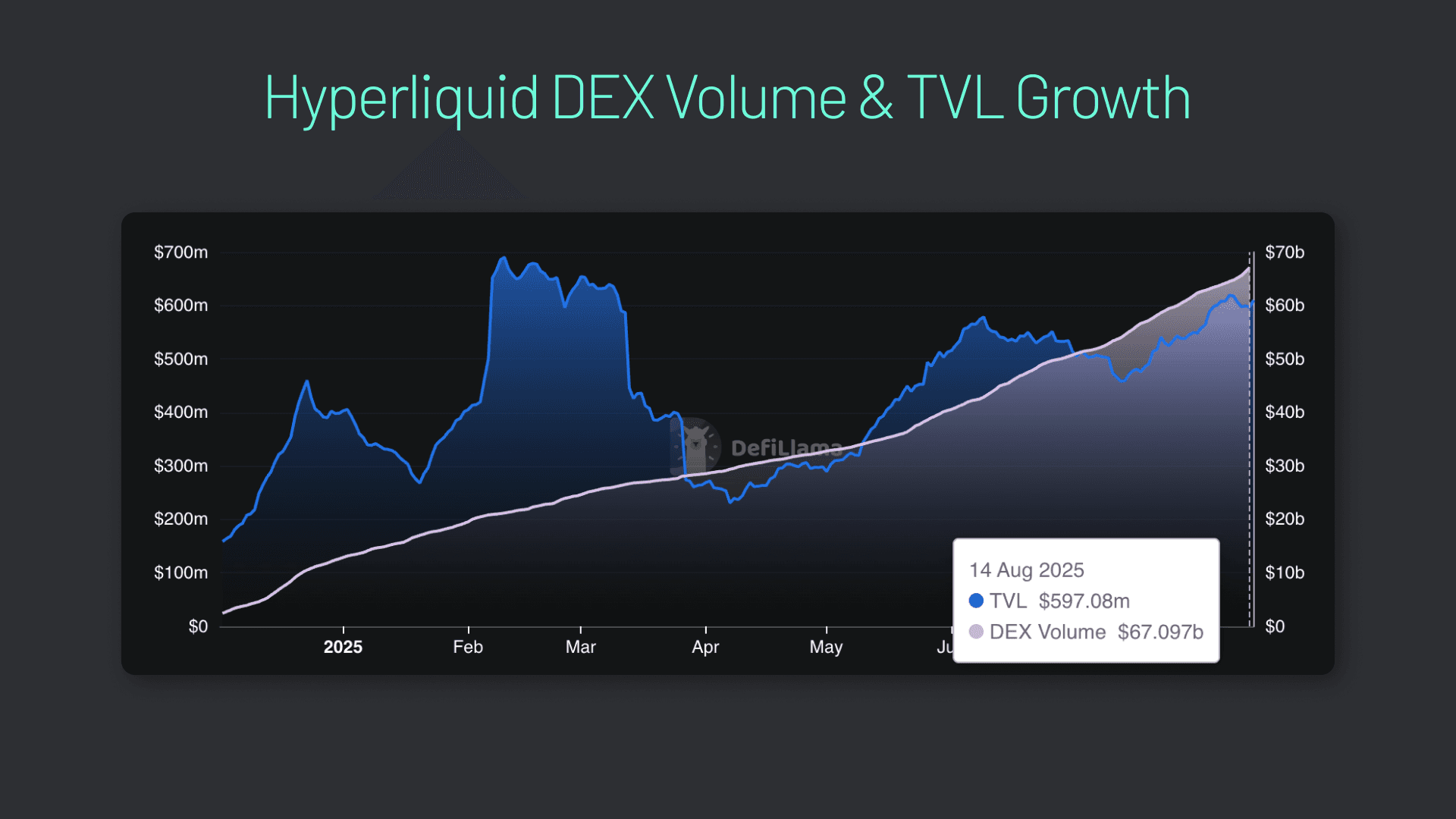
- Hyperliquid: Deep liquidity and tight spreads with ultra-low latency for reliable execution; leads with $75.4B 24h volume and $90.7B open interest. (Source)
- Lighter: Sub-5ms latency and up to 50x leverage with user-centric risk controls for rapid execution; $46.6B 24h volume. (Source)
- Paradex: Consistent execution despite lower volume of $1.19B 24h and $545M open interest, ideal for steady trading. (Source)
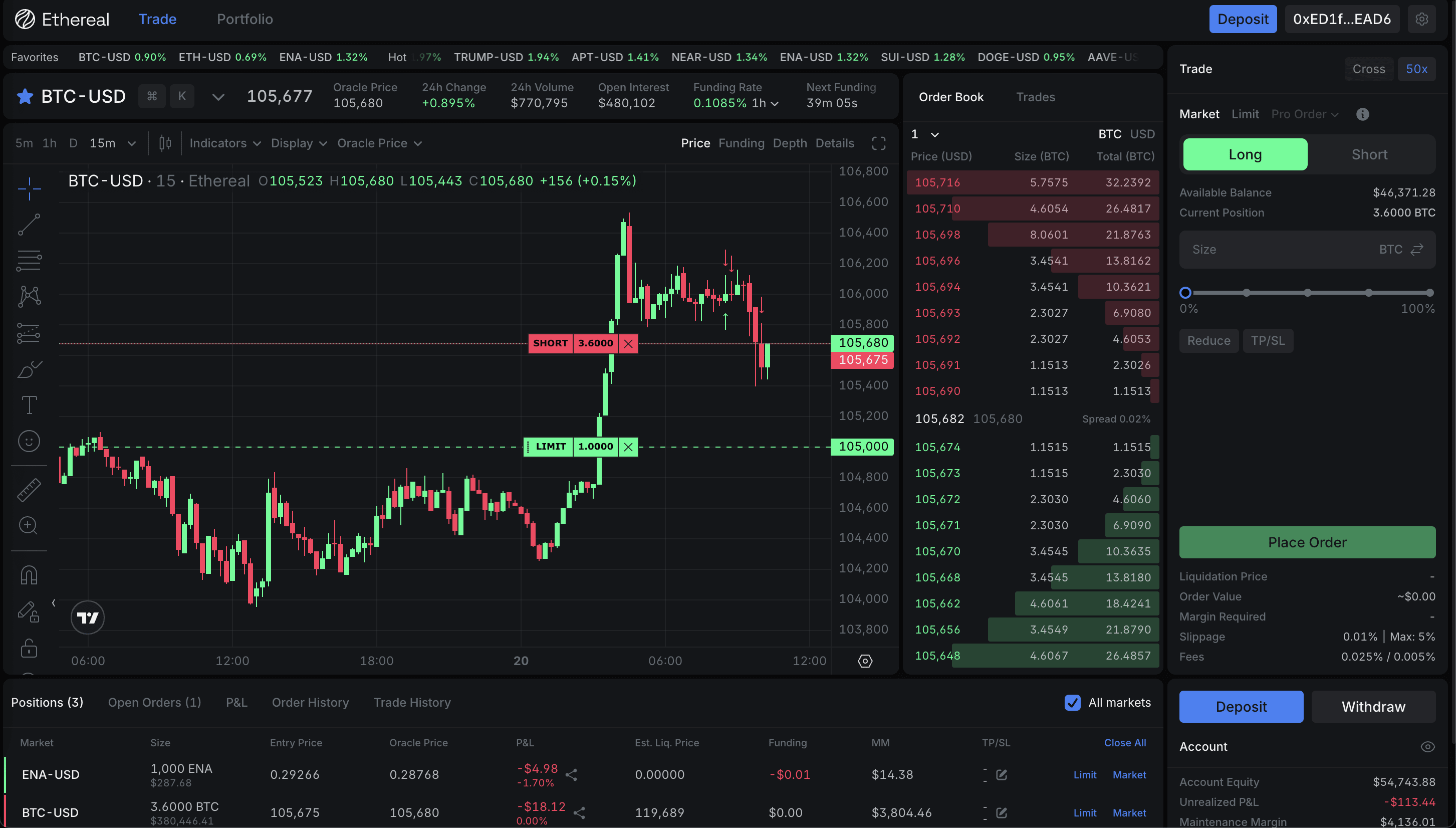
Lighter counters with sub-5ms latency and user-centric risk tools, supporting 50x leverage that thrills aggressive traders. This positions it well against Hyperliquid in architecture debates, though open interest trails. Paradex, with $1.19 billion volume and $545.38 million OI, offers reliable fills but lacks the depth for whale-sized plays, per recent market updates.
Traders prioritizing best perp DEX execution should weigh real-world tests: Hyperliquid's liquidity edge shines in volatile swings, while Lighter's speed suits momentum hunts. For deeper fee-liquidity interplay, Hyperliquid's maturity prevails, but Lighter's innovations signal a shift.
Volume Leadership: Hyperliquid's Grip vs Challengers' Surge
Volume reveals true adoption. Hyperliquid's $75.4 billion 24-hour volume as of January 9 dwarfs Lighter's $46.6 billion and Paradex's $1.19 billion, underscoring its market command. This liquidity moat translates to superior execution, tighter spreads, and reduced slippage - critical for hyperliquid volume comparison.
Lighter's climb impresses, fueled by zero fees attracting retail floods post-2025 airdrops. Its volume-to-OI ratio hints at speculative fervor, contrasting Hyperliquid's steadier profile. Paradex trails but shows consistency, appealing to niche traders eyeing paradex trading fees 2026.
Check our perp DEX tier list for full rankings. As 2026 unfolds, watch if Lighter erodes Hyperliquid's lead or if Paradex carves a zero-fee niche.
Revenue streams tell a fuller story of endurance in this cutthroat space. Hyperliquid's tiered fees, paired with its colossal $75.4 billion daily volume, fuel robust protocol earnings that support ongoing development and liquidity incentives. Lighter's zero-fee gambit for retail, while volume-boosting at $46.6 billion, pressures margins; it relies on premium tiers or future tokenomics to bridge the gap. Paradex, with its matching zero-fee pitch, scrapes by on $1.19 billion turnover, hinting at a bootstrap phase rather than scale.
Hyperliquid (HYPE) vs Majors and Perp DEX Tokens: 6-Month Price Performance
Price comparison as of 2026-01-24, highlighting Hyperliquid's token amid Perp DEX volume leadership ($75.4B 24h vol, $90.7B OI)
| Asset | Current Price | 6 Months Ago | Price Change |
|---|---|---|---|
| Hyperliquid | $23.18 | $30.18 | -23.2% |
| Bitcoin | $89,450.00 | $65,000.00 | +37.6% |
| Ethereum | $2,956.41 | $1,800.00 | +64.2% |
| Solana | $127.00 | $45.00 | +182.2% |
| dYdX | $0.1705 | $2.00 | -91.5% |
| GMX | $7.30 | $40.00 | -81.8% |
| Gains Network | $0.9404 | $3.50 | -73.1% |
| ApeX Protocol | $0.3729 | $0.5000 | -25.4% |
Analysis Summary
Major cryptocurrencies like Bitcoin (+37.6%), Ethereum (+64.2%), and Solana (+182.2%) have surged over the past six months, while Hyperliquid (-23.2%) and other Perp DEX tokens (dYdX -91.5%, GMX -81.8%) have declined sharply, underscoring sector underperformance despite Hyperliquid's volume dominance.
Key Insights
- Hyperliquid's HYPE token down 23.2%, better than peers like dYdX (-91.5%) and GMX (-81.8%)
- Solana outperforms all with +182.2% gain over six months
- Perp DEX tokens lag majors amid Hyperliquid's $75.4B 24h volume lead vs Lighter ($46.6B) and Paradex ($1.19B)
- Token price declines contrast with Hyperliquid's superior OI ($90.7B) and fee revenue potential via HYPE staking
Real-time prices from CoinGecko (Hyperliquid, dYdX, GMX, GNS, APEX) and Yahoo Finance (BTC, ETH, SOL) as of 2026-01-24. 6-month changes from ~2025-07-28 historical data; volumes/OI from provided 2026 context.
Data Sources:
- Main Asset: https://www.coingecko.com/en/coins/hyperliquid/historical_data
- Bitcoin: https://finance.yahoo.com/quote/BTC-USD/history
- Ethereum: https://finance.yahoo.com/quote/ETH-USD/history
- Solana: https://finance.yahoo.com/quote/SOL-USD/history
- dYdX: https://www.coingecko.com/en/coins/dydx/historical_data
- GMX: https://www.coingecko.com/en/coins/gmx/historical_data
- Gains Network: https://www.coingecko.com/en/coins/gains-network/historical_data
- ApeX Protocol: https://www.coingecko.com/en/coins/apex-protocol/historical_data
Disclaimer: Cryptocurrency prices are highly volatile and subject to market fluctuations. The data presented is for informational purposes only and should not be considered as investment advice. Always do your own research before making investment decisions.
Execution quality ties directly to these dynamics. In stress tests, Hyperliquid's deep order books minimize slippage during volatility spikes, earning nods as the best perp DEX execution for institutions. Lighter's sub-5ms fills dazzle for scalpers, but thinner liquidity amplifies risks on outsized positions. Paradex suffices for retail but falters under pressure, per trader forums dissecting paradex trading fees 2026.

Layer in architecture: Hyperliquid's custom L1 delivers unmatched throughput, processing billions without centralized chokepoints. Lighter emphasizes modular risk engines, enabling 50x leverage with precision controls that appeal to degens. Paradex leans on Starknet for scalability, but adoption lags, positioning it as a dark horse in the perp dex tier list 2026.
Trader Scenarios: Match Platform to Strategy
For high-frequency retail warriors, Lighter's zero fees and blistering latency forge an edge in hyperliquid volume comparison plays, especially BTC perp scalps amid 2026's bull runs. Institutions, however, gravitate to Hyperliquid's fortress-like liquidity, where multimillion orders execute sans drama. Paradex suits conservative volume traders chasing costless consistency, though scaling limits curb ambition.
Simulate a $1 million monthly portfolio: Hyperliquid costs ~$450 in taker fees, halved via staking; Lighter nets zero for retail; Paradex matches gratis but with execution trade-offs. Fundamentals dictate blending them - allocate 60% Hyperliquid for core exposure, 30% Lighter for opportunistic bursts, 10% Paradex for fee arbitrage.
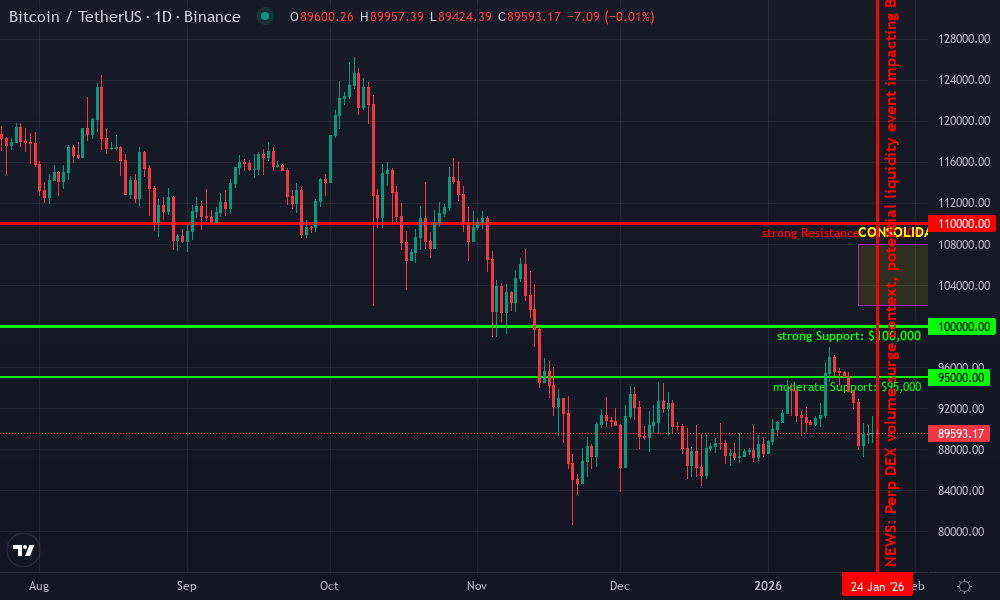
Bitcoin Technical Analysis Chart
Analysis by Market Analyst | Symbol: BINANCE:BTCUSDT | Interval: 1D | Drawings: 8
Technical Analysis Summary
To annotate this BTCUSDT chart in my balanced technical style, start by drawing a primary downtrend line connecting the September 2026 high at $118,000 (2026-09-10) to the December 2026 high at $110,000 (2026-12-20), with extension to current levels around $105,000. Add an emerging uptrend line from the November 2026 low at $90,000 (2026-11-15) to the recent February 2026 swing low at $102,000 (2026-02-05). Mark horizontal lines at key support $100,000 and resistance $110,000. Use Fibonacci retracement from the November low to December high for potential pullback zones (38.2% at $105,500, 50% at $104,000). Rectangle for the late December to early January consolidation between $102,000-$108,000. Arrows for volume divergence callouts and MACD bearish crossover. Vertical line for the mid-November breakout attempt. Text boxes for entry/exit zones and risk notes. This setup highlights the battle between bears and bulls in a medium-risk correction phase.
Risk Assessment: medium
Analysis: High volatility in 2026 BTC amid Perp DEX competition, key levels at play but no clear trend dominance; suits medium tolerance
Market Analyst's Recommendation: Wait for $100k hold or break for directional trades, favor longs with tight stops given liquidity depth
Key Support & Resistance Levels
📈 Support Levels:
- $100,000 - Strong support at psychological $100k, confluence with prior lows and uptrend line strong
- $95,000 - Moderate support near Nov swing low extension moderate
📉 Resistance Levels:
- $110,000 - Key resistance at Dec high, previous peak strong
- $108,000 - Near-term resistance at recent pullback high weak
Trading Zones (medium risk tolerance)
🎯 Entry Zones:
- $102,500 - Long entry on bounce from uptrend line and $100k support zone medium risk
- $98,500 - Aggressive short entry on breakdown below $100k high risk
🚪 Exit Zones:
- $108,000 - Profit target at minor resistance 💰 profit target
- $99,500 - Stop loss below key support 🛡️ stop loss
- $112,000 - Extended profit target if breakout 💰 profit target
Technical Indicators Analysis
📊 Volume Analysis:
Pattern: bearish divergence
Volume decreasing on recent upmove from $102k to $108k, signaling weakness
📈 MACD Analysis:
Signal: bearish crossover
MACD line crossed below signal in late Jan 2026, confirming downside momentum
Applied TradingView Drawing Utilities
This chart analysis utilizes the following professional drawing tools:
Disclaimer: This technical analysis by Market Analyst is for educational purposes only and should not be considered as financial advice. Trading involves risk, and you should always do your own research before making investment decisions. Past performance does not guarantee future results. The analysis reflects the author's personal methodology and risk tolerance (medium).
Looking ahead, Hyperliquid's moat seems unbreachable short-term, its $75.4 billion volume a testament to network effects. Yet Lighter's surge signals innovation disrupting stasis, potentially flipping rankings if zero-fee virality sustains. Paradex needs a catalyst to leapfrog, perhaps integrations or yield hooks. As a fundamentals-first investor, I favor Hyperliquid for its decade-spanning resilience, but diversify across these titans. Monitor volume leaders closely; the perp DEX wars reward the adaptive.




No comments yet. Be the first to share your thoughts!