

The perpetual decentralized exchange (Perp DEX) landscape has transformed dramatically in 2025, with daily trading volumes and user adoption reaching all-time highs. For traders seeking the best perp DEXs of 2025, understanding where liquidity, innovation, and transparency intersect is critical. This guide compares the top five platforms by daily volume provides Hyperliquid, dYdX, GMX, Lighter, and GRVT: to help you navigate the most competitive venues for perpetual trading.
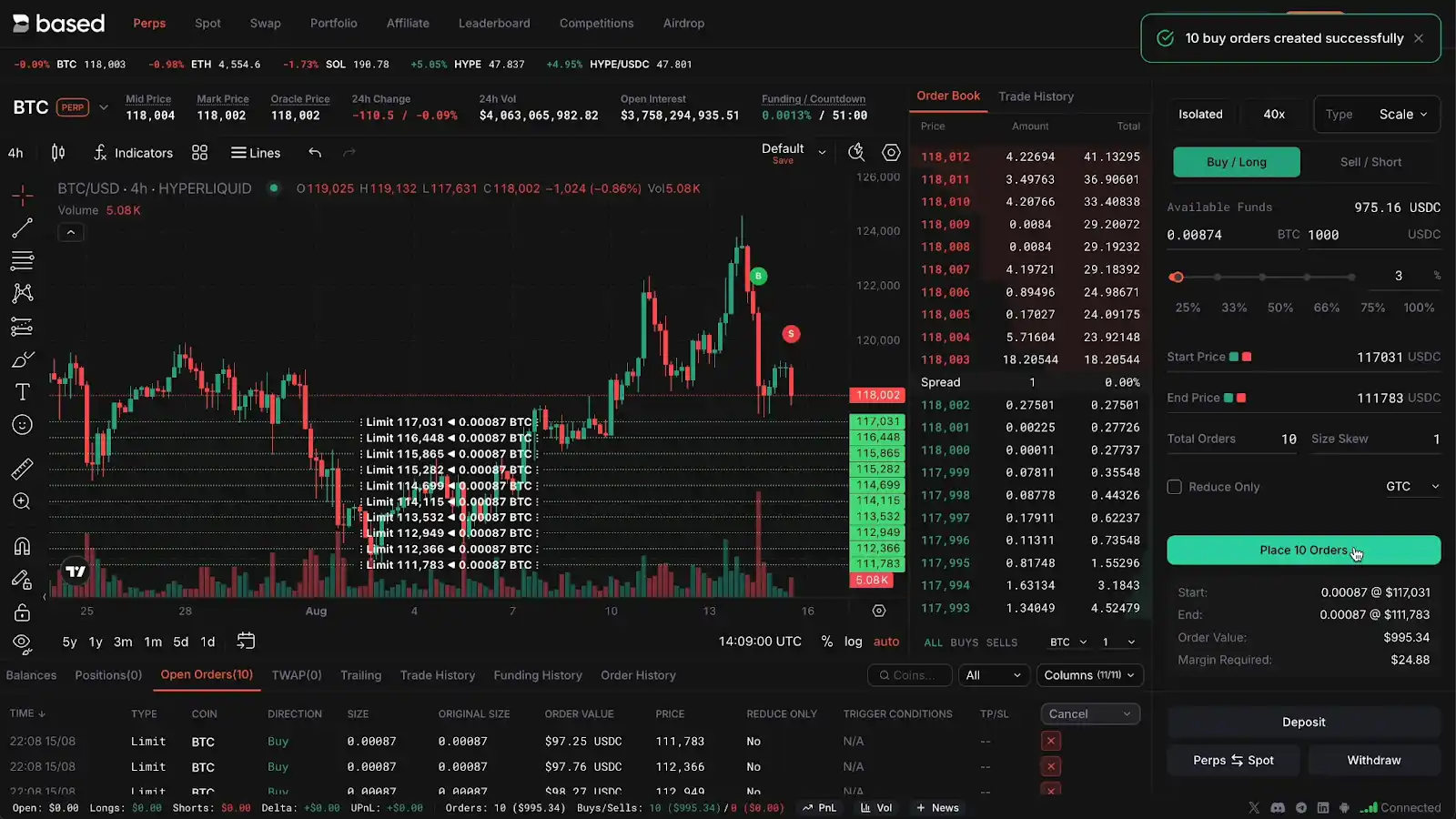
Why Daily Trading Volume Matters in Perp DEX Selection
Daily volume isn’t just a bragging metric, it’s a real indicator of a platform’s health, liquidity depth, and trader confidence. High volume means tighter spreads, faster order execution, and less slippage for both retail and professional users. In 2025, as decentralized derivatives have matured beyond their experimental roots, the top Perp DEXs now rival or surpass some centralized exchanges in raw activity and market share.
Choosing a high-volume exchange can also mean better risk management tools and access to more diverse markets. Traders today expect not only crypto perpetuals but also exposure to synthetic stocks and forex pairs, all with robust on-chain transparency.
The Top 5 Perpetual DEXs by Daily Volume: November 2025 Snapshot
Let’s break down what sets each of these leading platforms apart for active traders:
Top 5 Perp DEXs by Daily Volume in 2025: Comparative Overview
| Exchange | Daily Volume | Max Leverage | Fees (Maker/Taker) | Collateral Types | Assets Supported | Notable Features |
|---|---|---|---|---|---|---|
| Hyperliquid | $9.02B | 40x | 0% / 0.05% | USDC | 100+ perpetual markets | Deep liquidity, native Layer-1 (HyperBFT) |
| dYdX | $270M | 50x | -0.011% / 0.05% | USDC | 220+ perpetual markets | Cosmos-based chain, longest track record |
| GMX | Data not available | 50x | 0.02% / 0.07% (typical historical) | ETH, USDC, USDT | Crypto majors and select altcoins | Decentralized price oracles, Arbitrum & Avalanche support |
| Lighter | $10.13B | 50x | 0% retail, 0.002% / 0.02% premium | USDC | Broad perpetual coverage across majors and long-tail tokens | zk verification, zero-fee retail trading |
| GRVT | Data not available | 50x (est.) | 0.015% / 0.04% (est.) | USDC, USDT (est.) | Crypto perpetuals (est.) | Institutional-grade security, hybrid orderbook (est.) |
- Hyperliquid: The current pace-setter for on-chain derivatives. Built on its native Layer-1 (HyperBFT), Hyperliquid boasts deep liquidity with daily volumes consistently above $9 billion. Its zero maker fee model and broad asset support have made it a magnet for both whales and algorithmic traders.
- dYdX: A pioneer that continues to evolve on its Cosmos-based chain. While its daily volume ($270 million) is lower than some rivals this year, dYdX remains the gold standard for security-conscious traders who value transparency and a proven track record.
- GMX: Known for its unique multi-asset pools and community-driven governance. GMX has maintained strong volumes throughout 2025 thanks to its innovative approach to liquidity provision and competitive fee structure.
- Lighter: The disruptor with zero-fee retail trading powered by zk verification technology. Lighter’s $10 and billion daily volume reflects surging demand from users who want scalable performance without sacrificing decentralization or privacy.
- GRVT: The institutional favorite this year. GRVT offers tailored risk controls and advanced analytics that attract sophisticated traders seeking both compliance features and high throughput.
The State of Perpetual Exchange Liquidity in Late 2025
This year has seen trading volumes across all major Perp DEXs surge past previous records, reflecting both the influx of new capital into DeFi and improved user experiences across protocols. According to recent data from CoinGecko and DefiLlama, aggregate decentralized exchange volume now averages nearly $9 billion per day, a testament to how far on-chain derivatives have come since their early days.
The five leaders highlighted here account for a significant share of this activity due to their relentless focus on product innovation:
- Lighter’s zero-fee structure has forced competitors to revisit their pricing models.
- Hyperliquid’s deep liquidity pools are attracting high-frequency strategies previously exclusive to CEXs.
- dYdX continues to build trust through open-source smart contracts and transparent insurance funds.
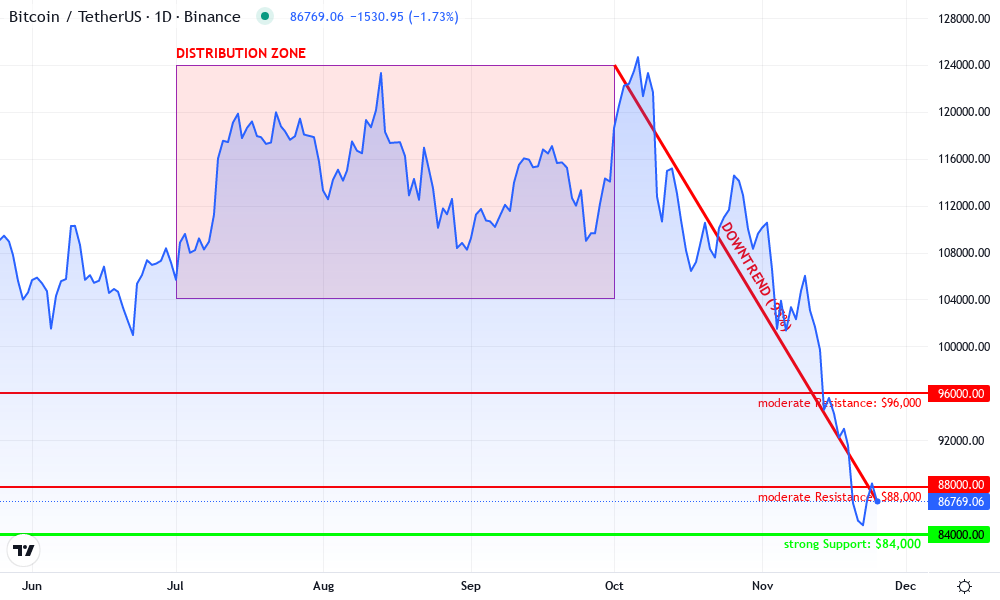
Bitcoin Technical Analysis Chart
Analysis by Trevor Maddox | Symbol: BINANCE:BTCUSDT | Interval: 1D | Drawings: 5
Technical Analysis Summary
Given the sharp drawdown in BTCUSDT from the $124,000 area to the current $86,833, I would begin by drawing a major downtrend line from the October peak to the latest price. Mark horizontal support at the recent low near $84,000 and resistance at the $88,000 level. Identify the large distribution range from July to October between $104,000 and $124,000, and mark the recent rapid selloff zone from $104,000 down to $86,000. Highlight the bounce attempt in late November. Use rectangles for range zones, trend_lines for the downtrend, and horizontal lines for support/resistance. Add callouts for volume/MACD analysis if available and arrow markers for significant pivots.
Risk Assessment:medium
Analysis: While the market looks heavily oversold after a vertical drop, no strong reversal signal has emerged yet.Downside risk remains if $84,000 fails,but risk/reward is improving for tactical longs if support holds.
Beyond headline figures, the quality of liquidity and the underlying technology stack remain critical for discerning traders. GRVT, for instance, has carved out a niche with its institutional-grade compliance and analytics suite, an edge in a market where regulatory scrutiny is intensifying. On the other hand, GMX’s community-driven approach continues to foster innovation around liquidity incentives and governance, ensuring strong user alignment as protocol upgrades roll out.
Key Trends Shaping Perpetual DEXs for 2025
Several trends are defining the competitive landscape among top perp DEXs for traders this year:
- Multi-chain expansion: Platforms like Lighter and GRVT are pioneering cross-chain settlement, enabling users to seamlessly trade perpetuals across multiple blockchains without bridging risk.
- Tokenized stocks and synthetic assets: Both Hyperliquid and GMX have expanded their asset lists to include synthetic versions of US stocks and forex pairs, broadening access while keeping everything on-chain.
- User rewards and gamification: Points-to-equity systems (as seen on EdgeX) are influencing competitors; GMX’s veGMX staking and Lighter’s loyalty programs are just two examples driving deeper engagement.
- Security through transparency: Open-source contracts and real-time proof-of-reserves audits are now table stakes. dYdX leads in transparency with its insurance fund disclosures and slashing mechanisms.
The race for dominance is not just about raw perpetual exchange daily volume in 2025. It’s also about who can deliver the most seamless, secure, and rewarding trading experience. As more retail investors enter the space, intuitive interfaces and educational resources will be key differentiators, areas where dYdX and Hyperliquid have both invested heavily this year.
Strategic Considerations: How to Choose Your Perp DEX
No single platform is perfect for every trader. Here’s how to align your strategy with the right venue:
- If you’re an active scalper or algo trader: Hyperliquid’s deep liquidity pools and ultra-low latency order matching stand out.
- If security is your top priority: dYdX’s open-source contracts, robust insurance fund, and proven history make it a safe harbor during market turbulence.
- If zero fees matter most: Lighter offers true zero-fee trading for retail users, a rare find at this scale.
- If you want exposure beyond crypto: GMX’s support for synthetic stocks plus GRVT’s expanding asset universe offer unique diversification opportunities.
The best approach? Diversify your activity across several platforms to maximize rewards programs while minimizing counterparty risk. As always, keep an eye on evolving fee schedules and new feature rollouts, rapid innovation means today’s advantages can quickly become tomorrow’s baseline expectations.
The rise of perpetual DEXs like Hyperliquid, dYdX, GMX, Lighter, and GRVT underscores how decentralized finance continues to push boundaries on speed, transparency, and user empowerment. For those ready to explore further or compare additional data points, including growth rates against last year, visit our latest research at this detailed analysis.
Tags
Related Articles

GMX vs Hyperliquid vs dYdX: BTC Perp Liquidity Comparison for Traders 2026
Bitcoin trades at $77,536.00 today, with a modest 24-hour gain of $1,602.00 or and 0.0211%, hovering between a high of $77,680.00 and low of $74,900.00. For perp traders chasing BTC exposure without expiry hassles, liquidity decides if you...
Apr 22, 2026
Gains Network gTrade Review: Trading AAPL Perp Stocks on Arbitrum with 50x Leverage
Apple Inc. (AAPL) trades at $259.20 today, reflecting a modest 24-hour dip of -0.49% from its recent high of $260.06 . For traders eyeing synthetic perpetuals on decentralized exchanges, Gains Network's gTrade offers a compelling avenue to...
Apr 14, 2026
Solana Perp DEX Comparison 2026: Bullet vs Aster vs Perpolator Fees and Leverage
Hey traders, Solana's perp DEX battlefield is exploding in 2026, snatching 26% of the global derivatives market and pumping over $1 trillion in monthly volume. With SOL at $82.52 after a -3.90% dip from its 24h high of $86.57, picking the...
Mar 28, 2026
Hyperliquid vs Paradex vs Variational: Perp DEX Comparison on Fees Leverage and Volume 2026
As perp DEX volume rocketed 346% to $6.7T in 2025 amid a total perpetuals market hitting $92.9T, traders shifted toward on-chain platforms like Hyperliquid , Paradex , and Variational . Hyperliquid grabbed headlines with up to 71% market...
Mar 20, 2026
No comments yet. Be the first to share your thoughts!