

Perpetual prediction markets have rapidly emerged as a transformative force in on-chain trading for 2025. Unlike traditional binary event bets, these markets enable continuous, leveraged speculation on real-world events, ranging from elections to macroeconomic data. The result is a new era of decentralized finance where information becomes tradable, programmable, and instantly settled. As regulatory clarity grows and major platforms integrate these features, perpetual prediction markets are fundamentally reshaping how traders and investors engage with event-driven finance.
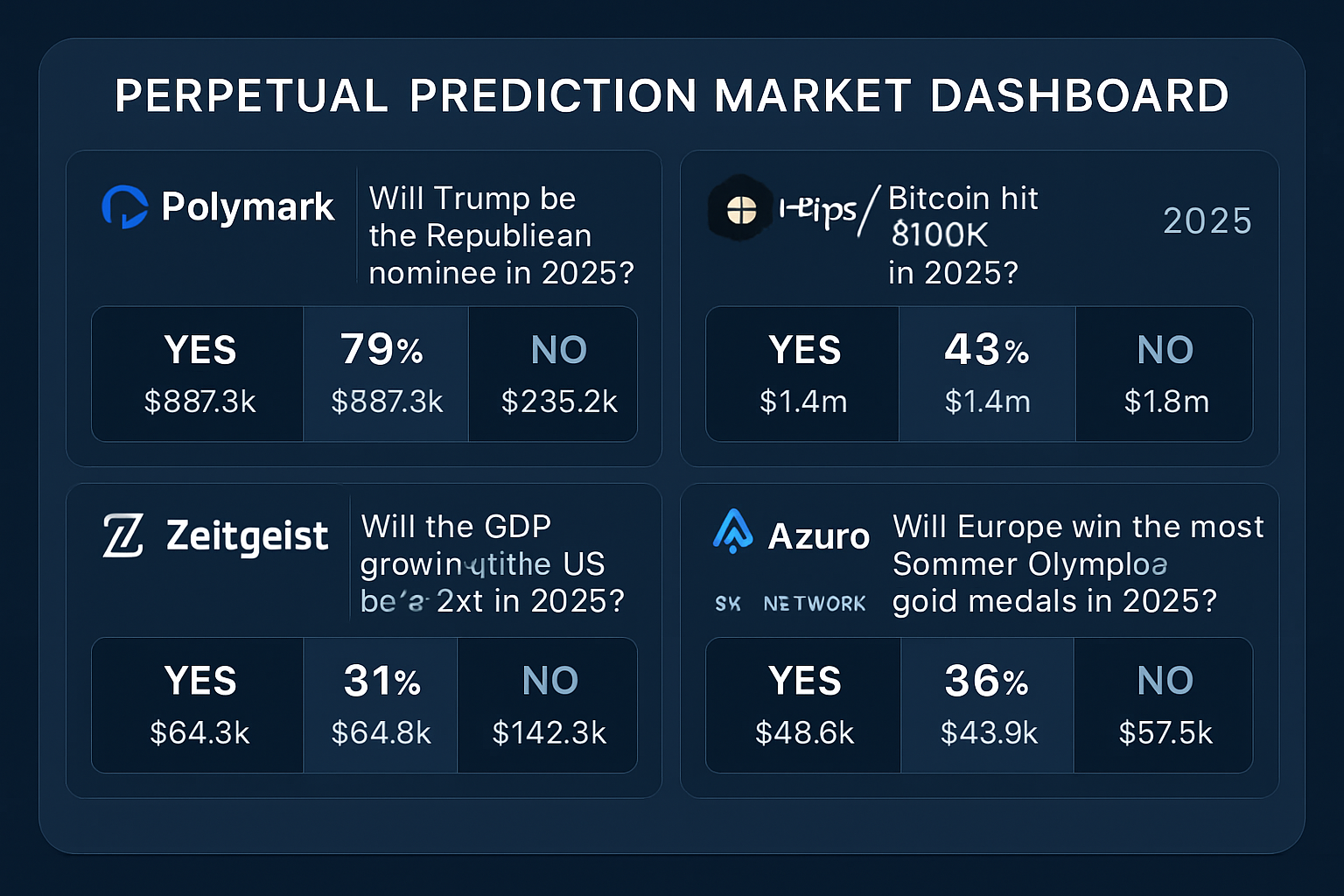
The Rise of Perpetual Prediction Markets in 2025
By late 2025, the perpetual futures model has been adopted by leading on-chain trading platforms to create round-the-clock markets for real-world events. This innovation is not just about betting on outcomes - it is about providing dynamic odds, leverage, and instant settlement within a fully decentralized infrastructure.
The top five platforms at the forefront of this revolution are:
- Polymarket
- Hyperliquid
- Zeitgeist
- Azuro
- SX Network
Together, these platforms represent the cutting edge of perpetual prediction market technology in DeFi. Let’s explore how each is driving innovation for traders seeking alpha from event-driven opportunities.
Key Drivers: Technology, Regulation and User Experience
The integration of perpetual prediction markets into mainstream wallets and DEXs has been a game changer. In October 2025, MetaMask’s launch of perpetual futures trading via Hyperliquid - alongside its planned integration with Polymarket - brought seamless event speculation directly into users’ wallets. This move reduced friction for millions of crypto users and set a new standard for user experience in on-chain trading.
On the regulatory front, Polymarket’s return to the U. S. market after securing CFTC approval signaled growing acceptance of event-based derivatives under established frameworks. The acquisition of QCEX allowed Polymarket to operate as a licensed clearinghouse while maintaining its decentralized ethos - a key milestone for legitimacy and institutional adoption.
This regulatory progress has inspired other platforms like SX Network and Zeitgeist to enhance compliance protocols without compromising their open-source roots or global accessibility. Meanwhile, Robinhood’s entry into prediction markets further validated the sector’s mainstream appeal by allowing retail traders to speculate on everything from central bank decisions to sports outcomes inside a familiar app interface.
Pioneers at the Forefront: Platform Innovations Unpacked
Polymarket, now operating under CFTC oversight in the U. S. , remains the world’s largest decentralized prediction market platform by volume. Its design allows users to trade outcome shares with deep liquidity pools and instant settlement thanks to advanced automated market makers (AMMs). Recent upgrades introduced perpetual contracts with no expiry date - letting traders maintain positions as long as liquidity persists or until the event resolves.
Hyperliquid, originally known for its lightning-fast spot and perp DEX infrastructure, added support for event-driven perps in early 2025. It offers professional-grade leverage (up to 20x), ultra-low fees, and cross-margining across crypto assets and real-world events alike - all directly on-chain with transparent risk management tools.
Zeitgeist, built natively on Polkadot parachains, pioneered customizable oracle feeds that allow communities to create bespoke event markets with dynamic odds adjustments based on real-time data flows. This flexibility has attracted DAOs seeking tailored hedging solutions or crowd-sourced forecasting for governance votes.
Azuro stands out by leveraging AI-powered liquidity routing across multiple blockchains to ensure tight spreads even in thinly traded niche events. Its modular architecture lets developers build verticalized applications (from sports betting to political forecasting) atop its core protocol - democratizing access while maximizing capital efficiency.
SX Network, meanwhile, continues its focus on community-driven governance and fee sharing models that incentivize both liquidity providers and informed speculators alike. With integrated social features such as leaderboards and copy-trading tools, SX Network makes perpetual prediction markets accessible even for less experienced DeFi participants.
Collectively, these platforms have transformed the landscape of on-chain trading by offering more than just speculation. They provide a robust infrastructure where information, liquidity, and user engagement converge. The perpetual model has eliminated the pressure of expiry dates, allowing traders to manage risk dynamically and respond instantly to new information as events unfold. This continuous market structure is especially attractive in volatile environments like elections, sports seasons, or rapidly evolving macroeconomic scenarios.
Volume and participation metrics are telling. In 2025, Polymarket’s notional volume soared during high-stakes events such as the U. S. presidential election, while Hyperliquid reported record growth in both active users and open interest on event-driven perps. Zeitgeist’s integration with DAOs for decentralized governance forecasting has set new standards for transparency and community involvement. Azuro’s AI-driven liquidity provision ensures that even obscure markets remain tradable with minimal slippage, a crucial advantage for sophisticated traders seeking edge in less crowded arenas. SX Network’s gamified approach has attracted a new generation of retail users eager to engage with prediction markets in a social, transparent setting.
The Strategic Edge: Leveraged Trading Meets Event-Driven Alpha
What truly sets perpetual prediction markets apart in 2025 is their ability to combine leveraged trading with dynamic odds on real-world outcomes, blurring the line between traditional derivatives and informational arbitrage. Traders can now deploy capital efficiently across a spectrum of events, utilizing cross-margining features (as seen on Hyperliquid) or customizing exposure via Zeitgeist’s oracle feeds.
For institutional players and sophisticated retail investors alike, this means new avenues for hedging macro risks or capturing alpha from informational advantages. For example, a trader anticipating central bank rate changes can take leveraged positions on Robinhood’s prediction market hub or SX Network’s event contracts, potentially outperforming passive strategies tied to traditional assets.
The instant settlement feature, now standard across these leading platforms, removes counterparty risk and accelerates capital rotation. This is particularly important for high-frequency traders and market makers who rely on rapid execution to maintain profitability.
Risks, Rewards and What Comes Next
While perpetual prediction markets offer compelling opportunities, they also introduce new challenges around liquidity fragmentation, regulatory scrutiny, and oracle reliability. Platforms like Zeitgeist are experimenting with decentralized dispute resolution systems to address manipulation risks; meanwhile, Azuro's AI models continuously monitor for anomalies in order flow or odds movement.
The regulatory landscape remains fluid but increasingly constructive, Polymarket’s CFTC approval is likely to serve as a blueprint for others seeking legitimacy without sacrificing decentralization. As more jurisdictions clarify their stance on event-driven derivatives, expect further integrations with mainstream wallets (like MetaMask) and fintech apps (such as Robinhood), driving adoption beyond crypto-native circles.
Looking ahead to 2026 and beyond, the convergence of AI-powered analytics, cross-chain interoperability (as championed by Azuro), and community-led governance (as pioneered by SX Network) will continue to push boundaries. Perpetual prediction markets are no longer a niche experiment, they’re an essential pillar of the modern DeFi ecosystem that empowers users to trade on information itself.



No comments yet. Be the first to share your thoughts!